Can a Tailor Alter a Suit or Dress for a Transgender or Nonbinary Person? What Danbury Residents Should Know
Yes — and honestly, this is exactly the kind of work a skilled tailor is built for. Off-the-rack clothing is designed around statistical averages, and those averages rarely match any one person’s body perfectly. For transgender and nonbinary individuals in Danbury and the surrounding area, that mismatch can feel especially frustrating. The good news is that alterations can close that gap in meaningful ways. Whether you’re a trans woman trying to get a dress to drape the way you want, a trans man who needs a suit jacket to sit properly across a broader back, or a nonbinary person who wants clothing that simply fits your body without conforming to a gendered silhouette — a tailor can help with all of it.
Why Off-the-Rack Fit Is Especially Challenging for Trans and Nonbinary Bodies
Here’s the core problem: clothing manufacturers design for a narrow range of assumed body proportions. Women’s suits assume a certain hip-to-waist ratio. Men’s dress shirts assume a certain chest-to-shoulder relationship. When your measurements fall outside those assumptions — for any reason — the garment fights you every time you put it on.
For transgender individuals, this shows up in specific, recurring ways. A trans woman might find that a dress fits beautifully in the shoulders but needs significant adjustments through the waist and hip. A trans man shopping for a suit might grab the right chest size and end up swimming in fabric through the waist, or find that the seat and thigh of a pair of trousers doesn’t accommodate his actual shape. These are solvable problems — they’re just not problems that go away on their own.
Nonbinary and gender-fluid customers face their own version of this: wanting a garment that reads a certain way visually without conforming to the fit standards of either traditional men’s or women’s sizing. A skilled tailor doesn’t think in those categories — we think in measurements, fabric, seam allowances, and what the garment needs to do. That’s actually freeing.
What a Tailor Can Actually Change
The range of alterations that can help with gender-affirming fit is broader than most people realize. Here are some of the most common adjustments:
- Taking in or letting out the waist and side seams — This reshapes the silhouette of a jacket, blazer, dress, or trouser to suit your actual waist-to-hip ratio, regardless of which direction that falls relative to the original design.
- Reshaping a jacket or blazer through the chest and shoulders — Shoulder seams are the foundation of a jacket’s fit. Moving them, or altering the chest panel, changes how the whole garment sits.
- Adjusting sleeve and trouser length — Simple hems, but they make a significant difference in how put-together a garment looks on your frame.
- Dart work on dresses and blouses — Darts can be added, removed, moved, or reshaped to change where a garment falls across the chest and torso.
- Modifying necklines, armholes, and strap placement — These changes are more involved but very doable on the right garment.
- Adding structure or softening a silhouette — Interfacing, padding, or removing shoulder structure can shift how a garment reads on your body.
The limits are usually set by the fabric itself and how much seam allowance was built into the original garment — not by any assumption about who the customer is or what they should be wearing.
Formalwear, Weddings, and Special Occasions
Formalwear is where fit matters most — and where the pressure is highest. If you’re attending a wedding in Ridgefield, heading to prom, or dressing for a job interview in downtown Danbury, you need to feel like the garment was made for you, not like you’re negotiating with it all day.
For trans women and femme-presenting nonbinary individuals navigating bridal or formal occasions, bridal and formal gown alterations can address everything from hem length and train adjustments to taking in a bodice or restructuring support. For trans men, transmasculine, and masc-presenting nonbinary individuals, suit and formalwear tailoring covers the full range of jacket tapering, trouser shaping, and sleeve work that turns an off-the-rack suit into something that actually fits the way a suit should.
In Newtown and Bethel especially, we see a lot of families preparing for milestone events — weddings, confirmations, graduations, proms — where everyone in the group needs to look polished. Trans and nonbinary family members deserve the same care and attention in that process as anyone else, and a good alteration appointment is a normal, practical step in getting there.
What to Expect at Your Fitting Appointment
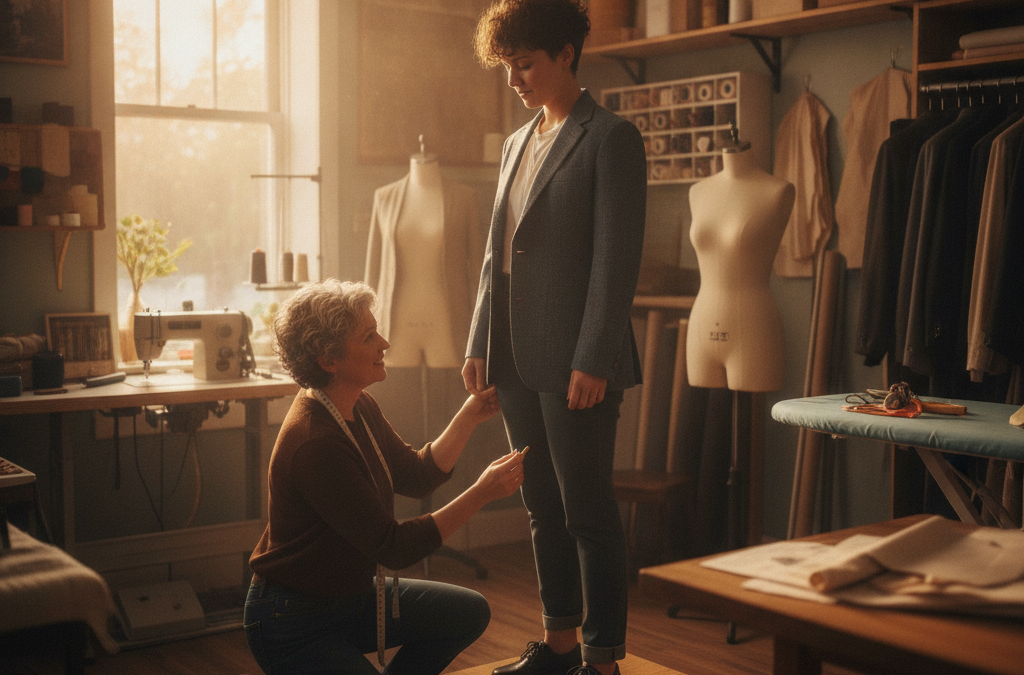
A fitting is just a fitting. You come in with the garment you want altered, and the tailor takes measurements and marks what needs to change. At Amina’s Alterations, the goal is to understand what the garment needs to do for your body — not to make assumptions about what you should want. You don’t need to explain yourself or justify your choices. You just need to tell us how the garment feels and how you want it to feel.
Be specific if you can. “This pulls across the back” or “I want this to sit closer to my waist” gives a tailor much more to work with than “something’s off.” Bring any shapewear, undergarments, or shoes you plan to wear with the garment — fit changes depending on what’s underneath it, and that matters for marking hems and checking drape.
For more complex reshaping jobs, expect two or three fittings rather than one. That’s not a sign anything is going wrong — it’s the normal process for structural alterations where you’re working against the original design of a garment rather than with it.
What About Repairs and Everyday Clothing?
It’s not always about formalwear. Sometimes it’s jeans that don’t work, a blazer that almost fits, or a shirt that needs to be let out through the back. Hemming and general repairs are the bread and butter of alteration work, and they apply just as much to everyday gender-affirming dressing as to special occasions. If you’ve found a piece that feels right in spirit but wrong in fit, bring it in. It’s often more fixable than it looks.
There’s also a sustainability angle worth mentioning — particularly in communities like New Milford and Fairfield County where the conversation around clothing repair and reducing waste has been growing steadily. Altering and repairing garments you already love is almost always more cost-effective than buying new, and it’s better for the environment. That matters regardless of what kind of clothing you’re wearing.
Frequently Asked Questions
Can a tailor alter men’s clothing to fit a trans woman’s body?
Yes. The structural differences in men’s and women’s clothing — darts, waist suppression, chest shaping — can be added or modified by a skilled tailor. The extent of the changes depends on the original garment’s construction and seam allowances, but most blazers, trousers, and dress shirts have meaningful room to work with.
Can a tailor alter women’s clothing to fit a trans man or transmasculine person?
Absolutely. Removing or suppressing darts, broadening shoulder seams, adjusting chest fit, and reshaping waist seams can all shift how a women’s garment sits on a transmasculine frame. Some pieces are more adaptable than others — bring the garment in and we can tell you what’s possible.
Is the fitting process different for transgender or nonbinary customers?
The technical process is the same — measurements, pin-marking, fitting to your body. What differs is the conversation, and that’s something we take seriously. You direct the fitting. We follow your lead on how you want the garment to look and feel.
How long do gender-affirming alterations typically take?
Simple alterations — hemming, waist adjustments, sleeve length — usually take about a week. More structural changes, like reshaping a jacket through the chest or moving darts significantly, may take two to three weeks and involve more than one fitting. If you have a firm deadline, mention it when you call — rush turnaround is available for time-sensitive situations.
Do I need to know exactly what I want before I come in?
Not at all. Come in with the garment and a general sense of what feels wrong. A good tailor will ask the right questions and help you identify what changes will make the biggest difference. You don’t need to know the technical terminology — you just need to wear the garment and tell us what isn’t working.
Ready to Find a Fit That Actually Works for You?
At Amina’s Alterations in Danbury, every customer gets the same thing: a careful eye, honest advice, and alterations done right. Whether you’re working toward a specific occasion or just trying to build a wardrobe that fits your body the way it should, we’re here to help. Reach out through our contact page to schedule a fitting or ask any questions — there’s no pressure and no judgment, just good tailoring.