Can a Tailor Alter Clothes for a Plus-Size Body? What Danbury Women Should Know About Getting a Fit That Actually Works
Yes — and honestly, this is one of the places where a skilled tailor makes the biggest difference. If you wear a plus size and you’ve ever walked out of a store frustrated because nothing fit the way you hoped, you already know the problem: clothing manufacturers size for a narrow standard, and curvy bodies don’t follow narrow standards. The shoulders might fit but the waist won’t. The hem falls in the wrong place. A dress fits around the hips but gaps at the chest. A blazer buttons across the bust but hangs like a box everywhere else. None of that means the garment is wrong for you — it means it needs to be adjusted to fit you, not the other way around. At Amina’s Alterations in Danbury, this kind of work is a regular part of what we do, and there’s far more that’s possible than most people realize.
Why Off-the-Rack Fit Is Especially Inconsistent for Plus Sizes
Here’s something worth understanding before you even walk into a fitting room: the way plus-size clothing is drafted by manufacturers is often inconsistent — even within the same brand. Some labels simply scale up a straight-size pattern without adjusting for proportional differences in the bust, waist, hips, or rise. That produces garments that technically fit in one measurement but pull, gap, or bunch everywhere else.
This isn’t a you problem. It’s a pattern-grading problem. And it’s exactly why so many women in the Danbury area — and in Bethel, Newtown, Ridgefield, Brookfield, and across Fairfield County — find themselves holding a garment they love the look of but can’t wear comfortably without something being adjusted first.
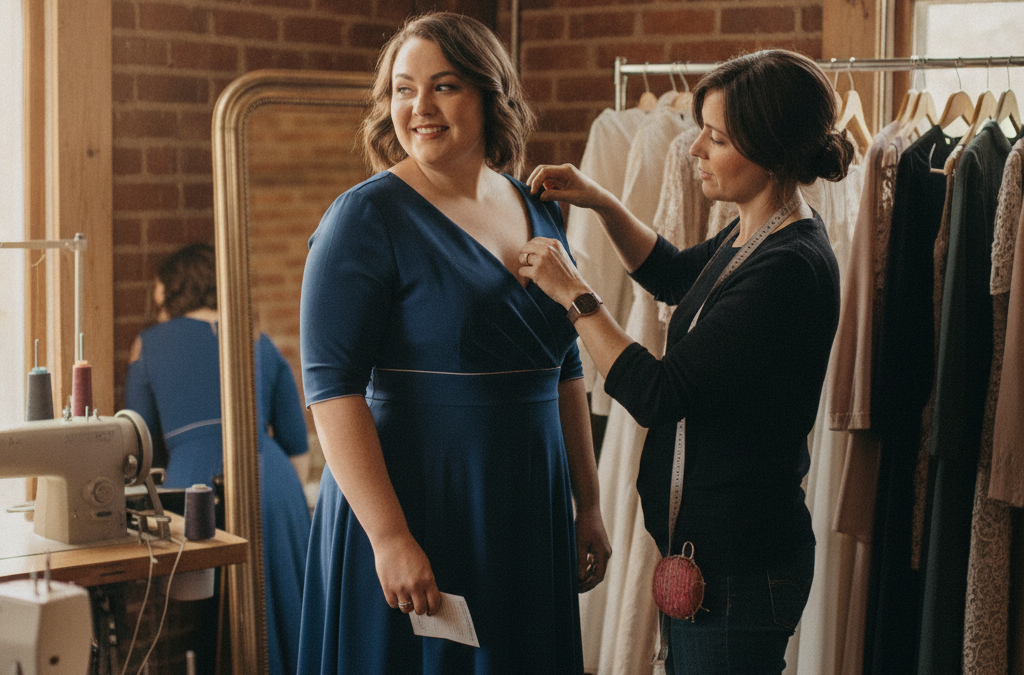
A tailor’s job is to look at a specific garment on a specific body and figure out what needs to change to make it work. That’s a very different skill from buying off the rack and hoping for the best.
What Alterations Actually Help Plus-Size Garments Fit Better
The good news is that there’s a lot that can be done — and most of it is more affordable than people expect. Here are the adjustments that come up most often:
- Taking in the waist when a garment fits in the hips or bust but is too loose through the midsection. This is one of the most common and straightforward alterations.
- Letting out seams when a garment is close to fitting but pulls across the hips, thighs, or shoulders. This only works if there’s adequate seam allowance in the fabric — which a tailor can assess at the first fitting.
- Raising or lowering a hemline to hit the right point on the leg, which changes dramatically depending on your height and proportions.
- Adjusting the bust area — adding a dart, taking in extra fabric, or reshaping the neckline so it lays flat rather than pulling or gaping.
- Shortening or adjusting sleeves when the arm length doesn’t match your proportions.
- Tapering a top or dress through the body to reduce excess fabric that makes structured garments look sloppy.
- Reshaping a waistband on pants or skirts that gap at the back even when the seat and thighs fit correctly — a very common frustration for curvy figures.
Some of these are quick fixes. Others take a fitting or two to get exactly right. Either way, the result is a garment that feels like it was made for your body — because after alterations, it essentially was.
Formalwear and Special Occasions: Where Fit Matters Most
If you’re shopping for a wedding, a prom, a gala, or any occasion where you’ll be photographed and you want to feel genuinely confident — this is where alterations go from nice-to-have to essential. Formal fabrics like satin, chiffon, and structured brocade don’t drape the same on every body, and what you see on a hanger or a fit model in a photo is not what you’ll see on yourself unless the garment is adjusted.
For brides especially, this matters enormously. Bridal gown sizing runs small compared to ready-to-wear, and the construction of most gowns — boning, structured bodices, long trains — means fit has to be precise. Bridal alterations for plus-size gowns often involve multiple fitting appointments, adjustments to the bodice and waist, hem and bustle work, and sometimes taking in or letting out across several panels at once. It’s detailed work, but it’s absolutely doable — and it makes the difference between wearing your dress and owning it.
The same principle applies to bridesmaid dresses, mother-of-the-bride gowns, and formalwear for proms and galas. If you’re ordering for a group event, it helps to schedule fittings early — ideally six to eight weeks out — so there’s enough time to make adjustments without rushing.
A Gap Most Local Tailors Don’t Address: Talking Honestly About What’s Possible
One thing you won’t always find at every alteration shop is a frank conversation about what a specific garment can and cannot do. Some shops will take your money and try — and you won’t find out until the final fitting that the seam allowance wasn’t there, or the fabric can’t be eased the way it needs to be, or the construction doesn’t allow for the change you wanted.
At Amina’s, that conversation happens first. Before any work is pinned or priced, we look at the garment with you — checking the seam allowance, the fabric weight and stretch, the construction details — and we’ll tell you honestly what’s achievable and what isn’t. If a garment has a half-inch seam allowance and you need two inches of room, we’ll say so upfront rather than let you find out later. That honesty is part of the service.
For everyday hemming and repairs, the process is usually fast and simple — many basic alterations can be turned around within a week. For more complex formalwear work, plan for two to three fittings over several weeks.
What to Bring to Your First Fitting
A few practical notes that’ll make your appointment go more smoothly:
- Wear — or bring — the undergarments you plan to wear with the garment. This matters a lot for how a bodice fits and where a hem falls.
- Bring the shoes you’ll be wearing, especially for any dress or pants that need hemming.
- If you have a reference photo or a specific fit goal in mind, bring it. It helps to be able to point to exactly what you’re going for.
- Don’t wait until two days before the event. The more time you give, the more we can do.
Frequently Asked Questions
Can any garment be altered to fit a plus-size body, or are there limits?
Most garments can be adjusted, but there are real limits — particularly when it comes to letting things out. If there isn’t enough seam allowance built into the garment, there’s nothing to work with. A tailor can assess this at a quick initial appointment before any commitment is made.
Is it more expensive to alter plus-size clothing?
Some alterations take more time on larger garments — longer hems, more fabric to work through — so pricing may be slightly higher for certain jobs. But the approach is the same and the work is entirely worth it. We’re happy to give you an estimate at your first fitting.
Do you work with plus-size brides in the Danbury area?
Absolutely, and we do it regularly. Bridal gown alterations for plus-size brides are a meaningful part of what we do. Schedule your first fitting as early as possible — ideally four to six months before your wedding date if you can.
What if I bought something online and it doesn’t fit my proportions at all?
That’s one of the most common reasons people come to us. Online shopping is especially tricky for plus-size shoppers because sizing is so inconsistent across brands. In many cases, a good tailor can bring an online purchase into shape — sometimes with just one or two adjustments.
Do you serve customers from Bethel, Brookfield, and other towns near Danbury?
Yes — we regularly work with customers from Bethel, Brookfield, Newtown, Ridgefield, and across Fairfield County. If you’re traveling in from one of those towns, it helps to call or message ahead so we can make the most of your visit.
You Deserve Clothes That Fit the Body You Have Right Now
There’s no reason to keep shoving yourself into garments that almost work — or avoiding events because you can’t find something that fits right. A good tailor doesn’t just fix clothes. She helps you feel settled and confident in what you’re wearing, whatever the occasion.
If you’re in the Danbury area and you’ve been holding off on having something altered because you weren’t sure it was possible, come in and let us take a look. Chances are, there’s more that can be done than you think. Reach out to Amina’s Alterations to schedule your fitting — we’d love to help you find a fit that actually works.